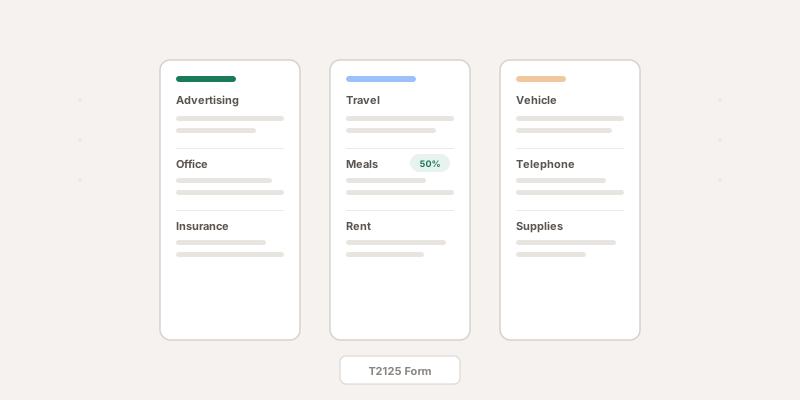
The T2125 form — Statement of Business or Professional Activities — is how self-employed Canadians report their business income and expenses. While the income section is straightforward, the expense categories trip up almost everyone. Here’s a definitive guide to where every expense belongs.
What Is the T2125 Form?
If you earn self-employment income in Canada — as a freelancer, sole proprietor, contractor, or professional — you file the T2125 alongside your personal T1 tax return. Whether you’re a real estate agent, IT consultant, or rideshare driver, the same form applies. It reports your gross business income, deducts eligible expenses, and calculates your net business income (what you actually pay tax on).
The more accurately you categorize expenses, the fewer questions the CRA will have if they review your return.
All Expense Categories with Examples
Advertising (Line 8521)
Costs to promote your business to potential clients.
Includes: Website hosting, domain registration, Google Ads, social media advertising, business cards, flyers, online directory listings, sponsored content
Does NOT include: Entertaining clients (that’s meals & entertainment), clothing with your logo (personal expense)
Meals and Entertainment (Line 8523)
Business meals with clients, suppliers, or at business events. Only 50% is deductible.
Includes: Restaurant meals with clients, coffee meetings, event tickets for client entertainment, conference meals not included in registration
Exception: Long-haul truck drivers can deduct 80% of meal expenses incurred during eligible travel periods. Other specific exceptions may apply — check the CRA’s current guidance.
You must record who you were with and the business purpose for every meal. “Lunch” on its own won’t survive an audit. Write it on the receipt or add a note when you scan it.
Bad Debts (Line 8590)
Amounts owed to you that you’ve determined are uncollectible.
Includes: Client invoices you’ve written off after reasonable collection efforts
Note: You must have previously included the amount in your income. You can’t write off a debt you never reported as revenue.
Insurance (Line 8690)
Premiums for business-related insurance policies.
Includes: Professional liability / errors & omissions insurance, commercial property insurance, business vehicle insurance (business-use portion), cyber liability insurance
Does NOT include: Personal health or life insurance (those may be deductible elsewhere), home insurance (portion goes under business-use-of-home)
Interest and Bank Charges (Line 8710)
Interest on money borrowed for business purposes and fees charged by financial institutions.
Includes: Business credit card interest, business loan interest, bank account monthly fees, payment processing fees (Stripe, Square), wire transfer fees
Does NOT include: Interest on personal loans, even if you used the money for business (you’d need a dedicated business loan)
Office Expenses (Line 8810)
Small, consumable items used in your office.
Includes: Pens, paper, printer ink, sticky notes, envelopes, postage stamps, cleaning supplies for your office
Key distinction: Office expenses are items you use up. Items that last longer (furniture, equipment) are either “supplies” or capital expenses.
Supplies (Line 8811)
Items used directly in your business that aren’t office consumables.
Includes: Raw materials, packaging materials, tools under $500, USB drives, phone cases for your business phone, small equipment
That office chair — is it “office expenses” or “supplies”? Neither. Office furniture is always a capital expense under CCA Class 8 (20% declining balance), regardless of cost. The CRA classifies all furniture as capital property.
Professional Fees (Line 8860)
Fees paid to external professionals for business services.
Includes: Accountant fees, bookkeeper fees, lawyer fees (business-related), consultant fees, tax preparation fees for your business return
Does NOT include: Personal legal fees (divorce, real estate), personal tax preparation
Management and Administration Fees (Line 8871)
Fees for management or administrative services.
Includes: Virtual assistant services, bookkeeping services (if not under professional fees), IT management services, co-working space management fees
This category overlaps with professional fees. The CRA doesn’t penalize you for choosing one over the other — just be consistent.
Rent (Line 8910)
Rent for business property you don’t own.
Includes: Office space rent, co-working space membership, equipment rental, storage unit rental for business inventory
Does NOT include: Home rent (that goes under business-use-of-home expenses, calculated separately)
Maintenance and Repairs (Line 8960)
Costs to maintain or repair business property and equipment.
Includes: Computer repairs, equipment maintenance, office renovations (if renting), vehicle repairs (business-use portion)
Does NOT include: Improvements that increase value (those are capital expenses), personal property repairs
Salaries, Wages, and Benefits (Line 9060)
Payments to employees (not subcontractors).
Includes: Employee salaries, employer CPP/EI contributions, health benefits you provide to employees
Does NOT include: Payments to subcontractors (those go under “other expenses” or “management fees”), your own salary (sole proprietors don’t pay themselves a salary)
Travel (Line 9200)
Costs of travelling for business purposes (not daily commuting).
Includes: Flights, hotels, train/bus tickets, taxis to the airport, travel meals (50% deductible), parking at airports
Does NOT include: Daily commute to your regular office, personal vacation extensions on business trips
Telephone and Utilities (Line 9220)
Communication and utility costs for your business.
Includes: Business phone line, cell phone plan (business-use portion), internet (business-use portion), electricity, heating, water for a business location, business software subscriptions (Zoom, Slack)
Note: If you use your personal phone for business, you can only deduct the business-use percentage. A 60/40 business/personal split means you deduct 60%. Home utilities go under business-use-of-home expenses, prorated by your office percentage.
Motor Vehicle Expenses (Line 9281)
Costs of using a vehicle for business — one of the most common deductions for construction contractors and photographers. You can use the simplified method (per-km rate) or the detailed method (actual expenses prorated by business km).
Simplified method: Multiply your business kilometres by the CRA’s per-km rate. For 2026, check the CRA website for current rates.
Detailed method includes: Gas, insurance, maintenance, lease payments or loan interest, licence and registration, parking (not at your regular office), car washes
You must keep a mileage log — date, destination, purpose, and kilometres driven for each business trip.
Property Taxes (Line 9180)
Property taxes on business property you own.
Includes: Municipal property taxes on a commercial office you own
Note: Home property taxes go under business-use-of-home, calculated as a percentage.
Other Expenses (Line 9270)
Anything that’s a legitimate business expense but doesn’t fit neatly into the above categories.
Includes: Business licence fees, professional membership dues, subscriptions to industry publications, subcontractor payments, training and education directly related to your current business
Don’t dump everything here. The CRA pays more attention to large “Other Expenses” amounts. If this line is disproportionately high, expect questions. Use the specific categories whenever possible.
Common Gray Areas
Is my home office chair “office expenses” or “supplies”?
Neither — furniture is always a capital expense under CCA Class 8 (20% declining balance), regardless of cost.
Software subscriptions — telephone, office expenses, or other?
Communication tools (Zoom, Slack) fit under telephone and utilities. Productivity software (Adobe, Notion) is better under office expenses. Industry-specific software (design tools, code editors) can go under other expenses.
Client gifts — advertising or entertainment?
Reasonable client gifts (such as a bottle of wine or small token) are generally deductible as advertising/promotion. If the gift involves food, drink, or entertainment, the 50% meals and entertainment limitation applies. The CRA doesn’t publish a specific dollar threshold for gifts — use good judgment and keep amounts reasonable.
Why Getting Categories Right Matters
Three reasons to take categories seriously:
-
Audit flags — The CRA’s algorithms compare your expense ratios to others in your industry. If your “other expenses” are 60% of your total deductions, expect questions.
-
Missed deductions — If you don’t know where an expense goes, you might skip it entirely. Canadians leave billions in unclaimed deductions on the table every year.
-
Consistency — Switching categories for the same type of expense year to year looks suspicious. Pick a category and stick with it.
Quick Reference Table
| Category | Line | Key Example |
|---|---|---|
| Advertising | 8521 | Google Ads, business cards |
| Meals & entertainment | 8523 | Client lunches (50% deductible) |
| Bad debts | 8590 | Uncollectible invoices |
| Insurance | 8690 | Professional liability |
| Interest & bank charges | 8710 | Stripe fees, loan interest |
| Office expenses | 8810 | Printer ink, paper, postage |
| Supplies | 8811 | Tools, raw materials |
| Professional fees | 8860 | Accountant, lawyer |
| Management fees | 8871 | Virtual assistant, bookkeeper |
| Rent | 8910 | Office space, co-working |
| Maintenance & repairs | 8960 | Computer repairs, equipment |
| Salaries & wages | 9060 | Employee pay, CPP/EI |
| Property taxes | 9180 | Commercial property tax |
| Travel | 9200 | Flights, hotels |
| Telephone & utilities | 9220 | Phone, internet, electricity |
| Motor vehicle | 9281 | Gas, maintenance (business %) |
| Other expenses | 9270 | Subscriptions, licences |
Manually sorting receipts into these categories is tedious and error-prone. ScanForTax uses AI to automatically read your receipts and map each expense to the correct T2125 category. Snap a photo, and the vendor, amount, taxes, and category are filled in instantly. When tax time arrives, export your expenses grouped by T2125 line number — ready to hand to your accountant.
This article is for informational purposes only and does not constitute legal, financial, or tax advice. The T2125 form and CRA guidelines may change — always verify current categories at canada.ca and consult a qualified tax professional for advice specific to your situation.